
Home » Early History » Railroads
Railroads
Railroads and Early Commerce Impacting Manitowish Waters
Railroads dramatically changed businesses and communities of the Northwoods, including Manitowish Waters. To truly understand the impact on Manitowish Waters, however, it is necessary to look at the broader geographic region.
Prior to the introduction of the railroad, it was rivers, lakes and wilderness trails that were well-worn, largely static routes of travel. The Manitowish Waters chain was one of the key hubs of river, lake and trail transportation for centuries. In the late 1880s, railroads created new and competing communities in the Northwoods that redirected regional commerce. Railroad access to the Manitowish Waters chain was limited and lagging compared to other regional communities.

1905 Map of Little Star Lake Landing and Logging Hoist
Wisconsin Historical Society WHI Image 89632
http://content.wisconsinhistory.org/cdm/singleitem/collection/maps/id/928/rec/5
Logging and mining drove early railroad construction in northern Wisconsin, dramatically expediting area settlement and development. Modern scholars divide logging and lumber industries into three different phases: 1) river drives of white pines, 2) railroad logging and harvesting remaining white pines, red pines, hardwoods and other trees, and 3) post-WWI small logging camps, using trucks and tractors. (1) Phase 1 river drives were also highly dependent on railroads and ships for transporting both logs and processed timber products. Loggers often used smaller, specialized rail systems to move logs deep in the woods to major railroad grades during Phase 2.
Railroads reached Park Falls in 1874 with full north/south rail service established by 1877. The real boom in railroad service to Manitowish Waters began in 1889 with the Chicago and North Western Railway reaching Powell and Manitowish, providing most of the logistical service for the emerging resort community of Manitowish Waters. A logging spur was added from just below Powell to Little Star Lake in 1900. Strong rail competition ensued, with the Milwaukee Road reaching the northern part of Manitowish Waters in 1905 with stops at Rice Creek, Big Lake, Clear Lake, Buswell and a few years later Rest Lake. Rail service slowly declined until it ceased in the mid-20th Century.
Full History
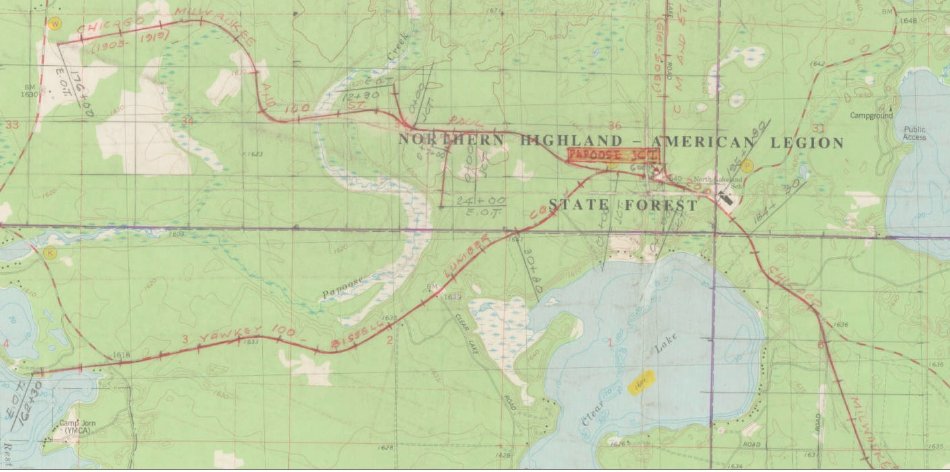
After dominating regional travel for centuries via water, Manitowish Waters became a secondary railroad destination, largely dependent on rail transport by 1889. Wagon roads were constructed to connect railroad depots and drop-offs with area businesses and residents. Water ways with launches and boats were also used to connect with both railroads stations and wagon roads. Horses, ponies and sometime oxen were essential for year round transportation until at least 1913. Many railroad grades that are not recorded on historic maps were likely “peggy-lines” or narrow gauge railroads for logging, or tertiary standard gauge rail lines for logging.(2) Thankfully, the efforts of modern scholar James P. Kayson has captured most rail lines on more recent topographical maps, illustrating in exciting detail the routes and ownership of area railroads.

Railroad Land Grants from both the state and federal government were used to support the construction of several Wisconsin rail systems. In particular, the Soo Line or Wisconsin Central Railroad received square miles or sections of land in a checkboard reaching 20 miles or more in either direction.(3) These land grants reached the western edge of Manitowish Waters and were in the path of the competing Chicago Northwestern Railroad when it reached Powell, WI, and Manitowish, WI in 1889.(4) Railroads typically held an advantage, compared to land speculators, logging companies and universities who all competed for access to government land. These land grants were used as an incentive/subsidy from both the federal and state governments to help “pay” for railroad construction. All land grants were controversial and were the subject of some of the greatest scandal and corruption in the 19th century.(5)


1874 Asher and Adams' Wisconsin Map
Wisconsin Historical Society Image ID # 73172
http://content.wisconsinhistory.org/cdm/singleitem/collection/maps/id/248/rec/2
In 1874 the Soo Line (Wisconsin Central) from Ashland, WI to just south of Fifield, WI marked the first regional railroad that impacted the Manitowish Waters area. The entire Soo Line was completed by 1877 linking the new railroad with the Flambeau River communities of Park Falls, WI and Fifield, WI. The Soo Line reached Ashland, WI to the north and Marshfield & Stevens Point, WI to the South.(6) Logic would suggest that by 1877 all Phase 1 logs driven by streams from the Manitowish Waters region would terminate at Park Falls and logs would be boomed or hoisted upon trains for transport. Surprisingly, all local historians insist that log drives from the Manitowish Waters area terminated in Chippewa Falls, WI and Eau Claire, WI.
Further research reveals the staggering influence of Lumber Baron Fredrick Weyerhaeuser and his “Syndicate” of 100 silent partners he controlled.(7) The “Syndicate” had at least 3 different corporations influencing of the operations of the Rest Lake Dam and logging camps. So, starting in 1888 when the Chippewa Lumber and Boom Company and others operated the Rest Lake Dam controlling early logging most of the 16 foot pine logs were driven far down stream to the Weyerhaeuser mills. Even though by 1889 the Northwestern Railroad had direct access to logs just a few miles downriver near the Manitowish Depot. The ultimate Pine Baron would use his substantial influence to direct logging of white pine in the Manitowish Waters area mostly down river to his mills, contributing to his ultimate worth of $30,000,000. Not bad for a poor German immigrant, but his tactics were challenged by small operators, newspapers and ultimately the government. In 1912, the Chippewa and Flambeau Improvement Company took over the operation of the Rest Lake Dam and the Weyerhaeuser “syndicate” continued to move their substantial lumber business west. Importantly, the Weyerhaeuser family also participated in philanthropy and were instrumental in creating the Brule River State Forest that protects all 44 miles of this historic river.
Certainly, the Soo Line (Central Wisconsin) from Marshfield & Stevens Point, WI to Ashland, WI moved substantial timber resources from the Flambeau River valleys, including the Manitowish River basin. Unfortunately, limited documentation and modern historian accounts of rail transport of early logging from the Manitowish Waters area to North Fork of the Flambeau River booms and hoists have been discovered. Although, “By the 1870s Henry Sherry owned a shingle mill and saw mill, and operated one of the largest lumber businesses in the state. During the 1880s he acquired extensive land holdings in the Flambeau River region from Cornell University and other sources, secured rail service to his holdings, and purchased a saw mill, dam, and water rights at Park Falls”. (8) Further, several citations support government agents and early homesteaders using the Soo Line (Central Wisconsin) to access the upper North Fork of the Flambeau and Manitowish Rivers in the 1880’s.
Between the late 1880’s to the beginning of the 20th Century the Chicago Northwestern Railroad and Milwaukee Railroad entered into an intense competition to access timber resources, capture prized land routes which facilitated more robust logging operations and developing tourism throughout northern Wisconsin. In the Manitowish Waters area, the Chicago Northwestern railroad was the clear winner, establishing in 1889 the most significant long term rail depot in the town of Manitowish, WI and a less used rail stop at Powell, WI.(9) The Chicago Northwestern line later extended access from a government logging spur line for the Flambeau Lumber Company just south of the Powell depot to Little Star Lake by 1900.(10) 16 Years later, the Milwaukee Road arrived on the northern shores and surrounding lakes of the Manitowish Waters with improved and direct rail service to Rice Creek, Big Lake, Clear Lake, Buswell, and later Rest Lake.(11)


Early 1900's Mantiowish Wi Depot
Voss Collection-Manitowish Waters Historical Society Catalog # 2018.4.3
http://mwhistory.pastperfectonline.com/photo/01E7DB2E-3B32-4C25-8A30-677031686352
Creation of the Manitowish, WI depot by Chicago Northwestern railroad established the most important travel and commerce link for the Manitowish Waters area from 1889 until the 1930’s. Historian Michael Dunn observes:
“It was built north in 1888 and where the track crossed the Manitowish River, the settlement of Manitowish developed (even before Mercer did!). It was a cluster of general stores, liveries, hotels, post office and homes. Supplies for the dam building crews, lumber camps and residents now could be wagon-hauled easily from Manitowish, or poled or rowed up the river in the bateaux that the Chippewa Lumber & Boom Company favored. For decades afterwards the railroad remained a lifeline, bringing up settlers, vacationists and supplies. Passenger train service ended just after New Years”.(12)


Immediately, the few non-logging residents surrounding the Manitowish chain began developing new forms of commerce.(13) Early on, sports magazines, railroad ads, and word of mouth targeted avid sportsman who sought spectacular hunting and fishing opportunities with relatively easier railroad access.(14) Camps, guide services, boat liveries and resorts simultaneously were developed to accommodate the demands of sporting men and women.
“Getting here, in those days, wasn't any too easy. North Western Railway Pullmans sped guests up from Indianapolis or Chicago or Milwaukee, but when they clambered down from the trains into the Manitowish dawn, it was a horse and buggy that awaited them, and a rough ride paralleling the river bank on the little lane to the dam site... the end of the road. Most resorts and some homeowners had big, gasoline-engined launches, and at the Rest Lake dam travelers and their baggage transferred to those for the last leg of the trip. (For travelers to Big Lake, two more transfers were ahead: an overland portage from Clear Lake to Big and then a boat trip on Big. Can you imagine moving up a piano in the face of such handicaps? One party did -- and it took days!)”.(15)

1905 marked aggressive competitions for railroad access to the communities in the Manitowish Waters area. The Chicago Northwestern Railroad continued their aggressive development, arching northeast reaching from Mercer to Winchester to Fosterville (Winegar/Presque Isle). At the same time the Milwaukee Road Line extended its rail line west to Boulder Junction in 1903, and then in 1905 raced to Papoose Lake creating the logging boom town of Buswell.(16)


Early 19th Century Fosterville or Winegar Logging Train
Langlade County Historical Society Collection
http://content.mpl.org/cdm/singleitem/collection/Langlade/id/327/rec/4
The shift northeast by the Chicago Northwestern railroad from Mercer impacted both logging and the tourist industry. These new rail lines created the modern communities of Winchester and Fosterville (also referred to as Winegar and Presque Isle). Winchester was already on the map because of Fay Buck’s Divide Resort. The narrows between North and South Turtle Lakes had been a hub of Buck’s resorts activities reaching south from Spider Lake to the upper peninsula of Michigan.(17)
“The Turtle Lake Company began operations out of Winchester in June of 1909. This company's rail lines fanned out in all directions reaching north into Gogebic County Mich., east to Harris and Birch Lakes, and [possibly] as far south as Circle Lily Lake. The C&NW provided rail to the company for construction of these lines. Operations ended in late 1926”. (18)
Paul Brenner describes the Vilas and Turtle Lake Companies using railroad cars to create mobile camps on both main and spur rail lines.
“In addition to putting permanent camps up both the Vilas County Lumber Company and the Turtle Lake Lumber Company, which was at Winchester, had what they called car camps which were camp buildings put on railroad cars. The bunkhouses the mess hall the barns and no doubt the blacksmith shop and maybe others. Whenever they got to wherever they were going to log they put in an extra spur and then the camp was set up for whatever length of time that they were going to log in that area. This picture here shows a good picture of a car camp on some lake. Again I don't know where it was. And this is the car barns from the Turtle Lake Lumber Company”.(19)
Interestingly, the modern Kaysen Railroad Maps for Winchester draws different conclusions regarding logging companies and rail usage south of Winchester. Kaysen’s analysis suggest the Flambeau Lumber Company operated two lines south of Winchester, one terminating along Highway W near the WinMan Trail entrance and the Wilderness Bar; while the second Flambeau Lumber Co. line terminated one and a quarter miles south of highway J on Circle Lily Road.(20)
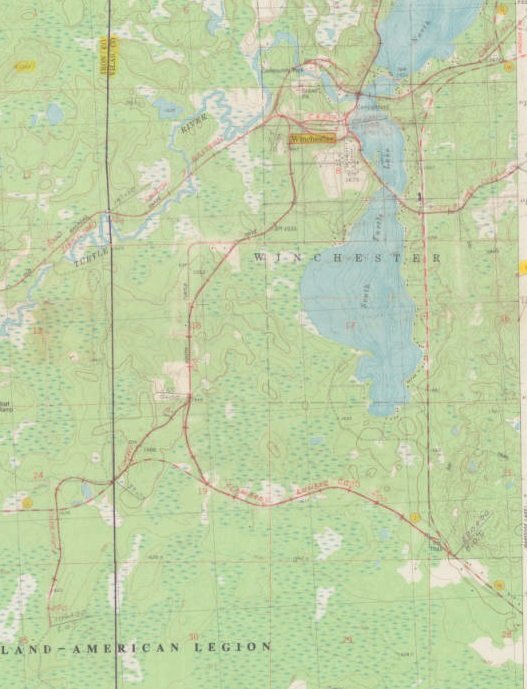
Fosterville had both strong logging influence and tourist development beginning in 1905. Rail access boosted the early resorts, fishing/hunting camps, and private cottages in the area. (21) Similarly, the logging and mill industries immediately took off,
“...Bonifas-Gorman Lumber Company. This line began in 1905 as the Vilas County Lumber Company Railroad. The mill was located in the village of Fosterville, which later changed its name to Winegar, and is today known as Presque Isle. Vilas County Lumber initially built southeast into the Oxbow Lake area, and also had a spur off of the C&NW Winegar branch that ran along Presque Isle Lake. Vilas County Lumber then located its operations in Gogebic County Michigan, and almost all subsequent track construction was in this county. Like the Turtle Lake Lumber Company, the C&NW provided all the rail and track construction material. In 1925 Vilas County Lumber became the Wm Bonifas Lumber Company. On Jan 1,1929 this in turn became the Bonifas-Gorman Lumber Company. Railroad operations continued up until 1934”. (22)

1909 Star Lake Country, Northern Wisconsin
Wisconsin Historical Society WHI ID 98378
http://content.wisconsinhistory.org/cdm/singleitem/collection/maps/id/1857/rec/1
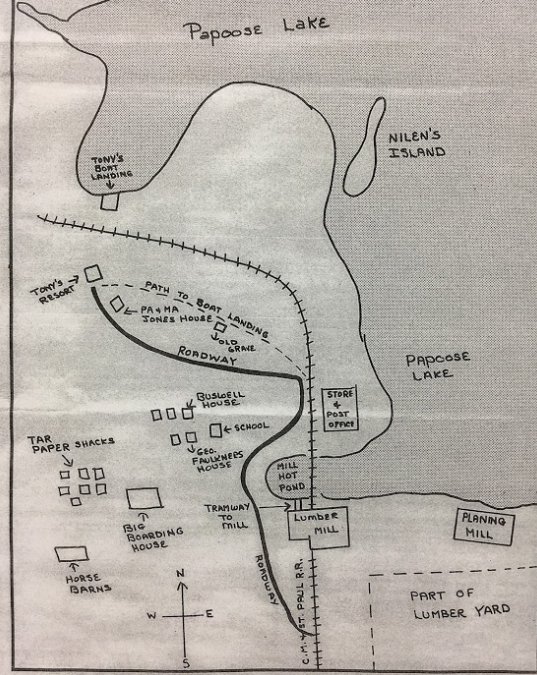
In 1905 the Milwaukee Road Line was extended from Boulder Jct. to Buswell on Papoose Lake. Buswell burned in 1910, but the line operated with a new depot at the junction of HWY K and West Papoose Lake road.(23) The Milwaukee Road line from Boulder Jct. to Buswell [area] remained in operation until 1919 serving various other logging interests and resorts on Rice Creek, Papoose Lake, Big Lake, Clear Lake, north of Rest Lake and Rest Lake with a spur to Riley’s hoist, due north across the bay from Camp Jorn at least by 1909.

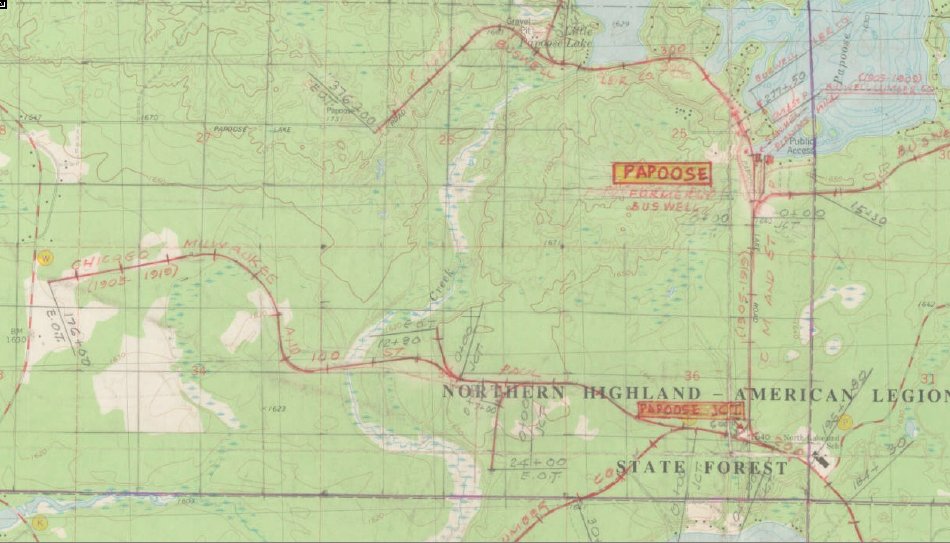


“Yawkey-Bissell's trains made extensive use of the Milwaukee's lines in the area….They made use of the branch line from Buswell to Boulder Jct. in order to reach a large block of timber west of Papoose Lake. Finally, In 1909 the Milwaukee Road entered into an agreement with the A.H. Stange Lumber company …The Milwaukee Road would provide rails (7 miles initially were leased to Stange) and cars to the company. Stange only needed to put together the trains for the Milwaukee to haul to Merrill. From 1909 until 1926 there were several spurs built off of Milwaukee lines in this fashion. One spur was located at the end of the Milwaukee's Papoose Lake Branch”. (24)
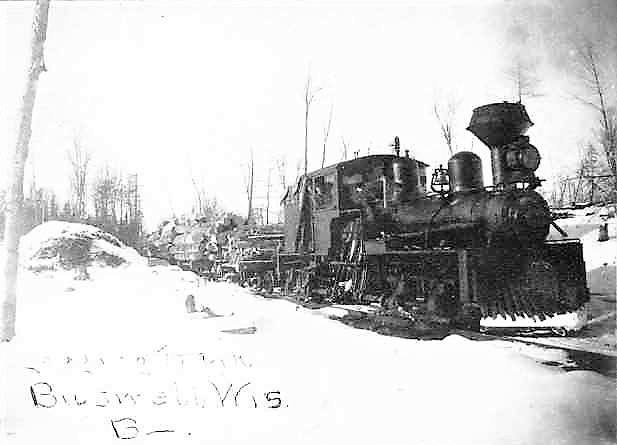

Early 1900's Little Star Lake Hoist
Sorvald Collection-Manitowish Waters Historical Society Catalog # 2018.4.19
https://s3.amazonaws.com/pastperfectonline/images/museum_936/001/2018419.jpg
In addition to using narrow gauge and peggy-lines, Phase 2 railroad logging utilized short run water routes to transport logs to rail heads. The Manitowish Waters chain and its tributaries to the north and east were perfect for this practice. Using steam paddle wheelers, booms, and rafts logs were gathered and hauled most often to The Reily Hoist on Rest Lake or the hoist on Little Star Lake. Michael Dunn cites:

“Two logging railroad spurs were pushed to the shores of the chain on Rest and Little Star lakes. Norway pine and other logs were put into the lakes of the chain and rafted by gas or steam tugs as quickly as possible to these two railroad landings and hoisted onto flatcars. These other species do not float as well as the white pine, so there was always a sense of urgency in rafting them, and rafting sometimes went on day and night. There was also a side track at Rice Creek Bridge where a self-propelled log loading crane could come and load logs rafted from the lakes of the chain or floated down from above Big or Round Lakes”.(25)
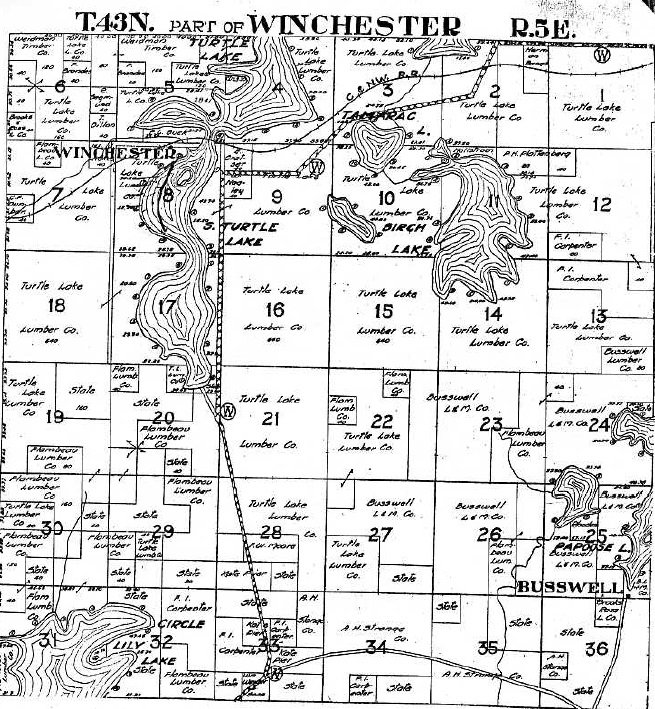
In the Manitowish Waters area both the Chicago Northwestern and Milwaukee lines serviced numerous lumber companies on the same rail lines and railroad spurs. Sometimes railroad spurs (both narrow and standard gauge) were built by mills in addition to the railroads; so owners of numerous rail lines could charge loggers for a single job. With different lumber companies using the same rail transport, identifying logs required stamp hammers like the hammers used on river drive logging. The mills sorted the logs according to ownership identified by stamps. The lumber mills would then back feed the data on specific logging companies’ timber footage to railroads to generate accurate transportation charges. (26) Early, plat maps reveal multiple logging companies using the same spur lines in the Manitowish Waters area around Rest Lake. (27)
Michael Dunn provides further insights regarding rail and water transport to rail hoists on the Manitowish Waters chain:
Hardwood logs were partially dried to ensure their staying afloat until another little lake boat, like the gasoline powered Skiddoo, could raft them to the two landings for loading on railroad cars. From the Star Lake spur track there also radiated little railroad spurs over which lightweight but standard gauge "Peggy" locomotives (geared locomotives, most likely of the shay or screwdriver variety) pulled in loads of logs from the woods; some of these temporary lines ran as far as Alder and Benson lakes. Big logging activity ceased between 1911 (when the last Yawkey-Bissell activity ceased; that firm's last local camp was near Mud Lake, now Fawn) and 1914 (when the last logs had been shipped from the hoist at Star Lake). In 1919 the Milwaukee Road removed its track along the north side of the chain; the spur to the C&NW was quietly taken up around the same time. (28)

Early 1900's Rest Lake Launch
Voss Collection Manitowish Waters Historical Society Catalog Number 2018.3.1
http://mwhistory.pastperfectonline.com/photo/672A8C47-9A69-4562-B091-224012264924
A point of frustration for the loggers using lakes and streams to tow rafts of logs to railroad hoists, was the tendency for red pine and all other trees (except white pine) to sink. Paul Brenner shared that he found oak trees cut into saw logs or bolts sunk in the bed of Rice Creek. These failed hardwood loggers learned a tough lesson attempting to access the hoist at the Rice Creek railroad crossing. Local scuba divers have reported all parts of the Manitowish Chain have sunken red pines along the bottom of the lakes; but Rest and Little Star lakes have the greatest number of sunken logs on their lake bottoms. In some areas, these submerged logs are stacked on top of one another.
At the turn of the 20th century railroads began to face some regulation by the Wisconsin State Legislature and enforced by the newly created Railroad Commission. Importantly, railroads were forced to add fire suppression technology to their trains and implement practices to minimize forest fires, these laws still remain in state statue.(29) Other regulations tended to parallel reforms being advanced by Progressives on the national level to protect consumers from monopolistic abuse of railroads.
Some of the earliest residents worked as market hunters and fishermen to sell wild game to logging camps, and began to extend the financial rewards of market hunting and fishing to fulfill demand for wild game in southern cities and towns. Railroads were a crucial link to make this questionable practice possible, transporting fresh fish and game to eager consumers. Sports fishermen quickly reported on popular sporting and outdoor magazines that portions of the Manitowish area have been fished out by market fishermen.(30) This news could be harmful to the fledging resort industry in Manitowish Waters. Importantly, Manitowish Waters’ area resort owners, guides, and merchants became extraordinarily proactive in maintaining local natural resources, because tourist had many competing destinations in the northwoods. The early railroads brought fish for stocking in large milk pails from the Woodruff and other hatcheries to replenish the lakes and streams in the Manitowish Waters area, ensuring a sustained and high quality fishery.(31) Additionally, town citizens sued the Chippewa and Flambeau Improvement Company in 1914 to codify and stabilize the water levels created by the dam. Court documents revealed dam operations seriously threatened fisheries and contributed to massive shoreline destruction. Town residents ultimately won these court battles, receiving favorable decisions throughout the appeal process over logging interests.(32) Railroads, resort owners and guides highly dependent on tourist commerce worked collectively in the early days to maintain wilderness areas with strong hunting and fishing.
Starting about 1910 the growing tourist industry was beginning to compete with the logging and lumber for rail use. The sale of cheap cutover land as well as some pristine parcels of land led to an upswing in private homes/cottages and resorts. With an extensive railroad infrastructure to service much of the northwoods a land boom of sorts began. Before 1900, land sales were suppressed, and controlled by manipulative land agents locked-in with land speculators, universities, railroads and logging companies.(33) Consequently, most Manitowish Waters early pioneers or homesteaders had to either petition much later for their families’ homesteads or wait to pay for deeded access to land they lived on for years.(34)
By 1912, the State of Wisconsin began to lease excellent lakefront properties making “owning” a part of the northwoods even more accessible. For $10 to $75 a year Wisconsin residents and those out of state could lease up to 5 acres of land with lake-frontage for 20 years with an option to renew.(35) In 1910, the vice President of the Chicago Northwestern Railroad endorsed development of northern lake districts as highly important for ongoing railroad commerce. Today, Rest Lake Park was the site of an old state lease that created, the Hoosier Camp.(36) With close proximity to the wagon roads to Manitowish, WI station, this site was one of many that expanded tourism and summer residents. Railroad passage also facilitated boys and girls summer camps springing-up on Alder, Spider, Big and Rest Lakes using both tents and cabins.(37)
Railroads could haul nearly anything from the industrial cities north to Powell, WI or Manitowish, WI. Summer residents and resort owners accelerated the transition from tent camps to cabins and homes.
“Supplies for many resorts, cottages and local settlers came by rail and stage to the dam. About 1907 resorter C.W. Buck and drayman Sherman from Powell carved out a road from Powell to a landing on Little Star Lake, which shortened rail, buggy and water travel and appealed to guests from Buck's, LaFave's and other resorts”.(38)
Local historian Mark Leistickow shared that the Flancher family on Manitowish Lake used mail order catalogs like Sears or Montgomery Ward to purchase prefabricated cottages and homes that could be hauled on a train as close as the Little Star Lake spur, Rice Creek stop, Clear Lake stop, or Rest Lake spur. The family photo collection of the Flancher family are among the earliest and most comprehensive of the early summer residents in Manitowish Waters. These mail order cottages are featured in their pictures and provide keen illustrations of how railroads empowered local development.
Michael Dunn provides even greater insights regarding the challenges and advantages of rail travel:
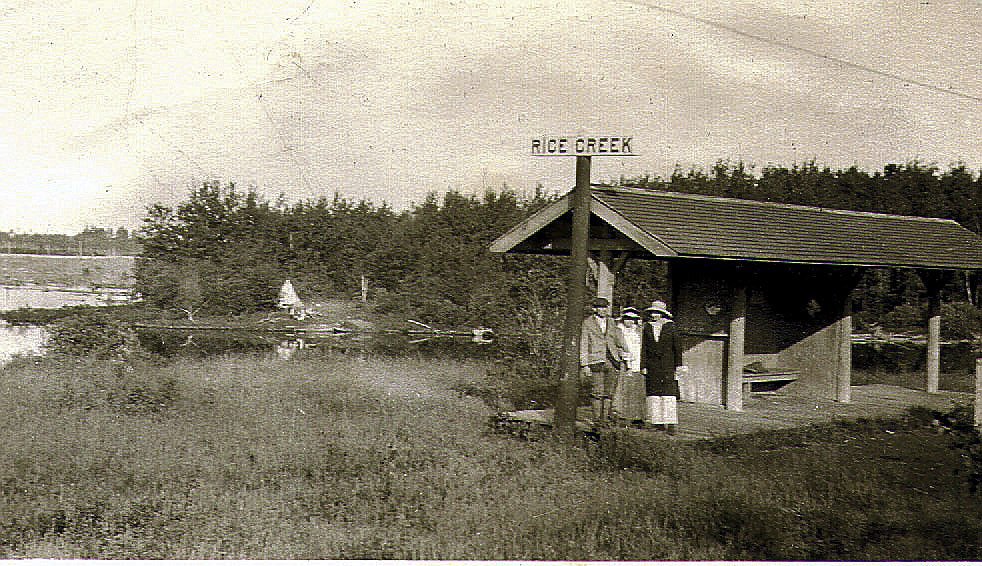
“The train was so slow that its folklore even today has rumors of the train crew getting off to go fishing. What actually delayed the train so much was the fact that it often handled local freight cars or long strings of log or lumber cars from Buswell, in addition to the coach; but that frequent freight role was a huge godsend to people living around the chain or north of it. The track crossed the waters of Rice Creek right above Island Lake. Not only could launches reach it to meet a long-suffering passenger or two, but building supplies, groceries and even beer that was shipped up in full boxcar loads could be transferred directly from train cars to lake launches or barges without any wagon haul at all”.(39)

Early 1900's Passenger Train on Rice Creek
Ticket to Buswell Catalog Number 2018.4.17
https://www.facebook.com/TicketToBuswell/photos/a.1635977279981942.1073741829.1635294486716888/1681200825459587/?type=3&theater
The different choices for modern railroad transport to the Manitowish Waters chain was certainly a hot topic in the community. Comparing costs, time requirements, schedules and quality of transport, travelers could switch between the Chicago Northwestern and/or the Milwaukee Road access the chain of lakes. By the 1920’s with the construction of Highway 10 automobiles and trucks began to slowly absorb the market for both passenger and material transport.
Phase 3 logging used rail transport far less, though Robert Loveless did set rails and tracks on his property to move logs from Alder Lake and the road to his mill. The tracks were also used to move milled lumber on the Loveless property into the 1950’s.
“The lone sawmill to operate after that era [phase 2 logging] in the area were operated by Bob Loveless, who cut timber in the few pockets of virgin forest during the 1920's, and Marvin Loveless, who ran a small mill into the 1940's or 1950's”.(40)
Certainly, the Phase 3 logs captured by lumberjacks using tractors and trucks benefited from rail transport, but by the end of the 1920’s the transition from railroads and large lumber camps was nearly complete. Though much of the heavy equipment Phase 3 loggers used from 1930-1960 still arrived via rail.
After World War I the old Milwaukee line rail stop at Rice Creek was purchased by The Newcomb family and became the residence of Dr. Kate Newcomb and her family. The storied Newcomb family arrived on the banks of Rice Creek in the early 1920’s and Dr. Kate undoubtedly used the old Milwaukee Railroad grades to access patients, as the legendary “Angel on Snowshoes”. Dr. Kate kept an office at Voss’ Resort on Spider Lake and became a national icon of rural medicine.
Perhaps the best way to contextualize the evolution of turn of the century railroads on the region, is through the pen of Earnest Hemingway. In his short story, Big Two Hearted River, Hemmingway captures the importance of rail transport, collapsed “boom towns”, post logging forest fires and adventurous fishermen “roughing it” to pursue trophy fish. Hemingway, an avid fisherman, places his character Nick Adams in the upper peninsula of Michigan, paralleling his own World War I and life experiences. I highly recommend (re)reading this classic short story, and see if your mind's-eye can place Nick Adams at the rail stop at the burned town of Buswell, camping along Papoose Creek in search of trout, seeking both peace in the northwoods and answers to life’s most challenging questions.
End Notes
1 http://dnr.wi.gov/wnrmag/html/stories/2004/feb04/forest.htm. Wisconsin Department of Natural Resources. Randall E. Rohe. Retrieved 1-26-2018.
2 http://mwlibrary.blogspot.com/2012/06/history.html. Koller Library. Michael J. Dunn, III. Retrieved 1-26-2018.
3 http://www.coxrail.com/land-grants.asp. Terry Cox. Retrieved 1-26-2018.
4 https://www.wisconsinhistory.org/Records/Image/IM89616. Map of Wisconsin Land Grant for the Wisconsin Central Railroad. Wisconsin Historical Society. Image # 89616. Retrieved 1-26-2018.
5 https://www.wisconsinhistory.org/Records/Newspaper/BA4803. Railroads Land Grants Cause State’s Greatest Scandal. Wisconsin Historical Society. Wisconsin State Journal. 9-17-1922. Retrieved 1-26-2018.
6 http://riptrack.net/wisconsin-19th. Wisconsin railroad timeline: 19th century. Retrieved 1-26-2018.
7 https://www.immigrantentrepreneurship.org/entry.php?rec=239#_ednref29. Immigrant Entrepreneurship. Fredrick Weyerhaeuser. Retrieved 1-26-2018.
8 http://digital.library.wisc.edu/1711.dl/wiarchives.uw-whs-mil000ek. Edward Paddock Sherry: Sherry Family Business Papers. Wisconsin Historical Society. Retrieved 1-26-2018.
9 http://riptrack.net/wisconsin-19th. Wisconsin railroad timeline: 19th century. Retrieved 1-26-2018.
10 http://content.wisconsinhistory.org/cdm/singleitem/collection/maps/id/1572/rec/4. Lakes tributary to G.W. Buck & Son resorts. Wisconsin Historical Society. Image # 97107. Retrieved 1-26-2018.
11 http://content.wisconsinhistory.org/cdm/singleitem/collection/maps/id/1857/rec/13. Star lake country northern Wisconsin. Wisconsin Historical Society. Image # 98378. Retrieved 1-26-2018.
12 http://mwlibrary.blogspot.com/search/label/trains. The resort era begins. Koller Library. Michael J. Dunn, III. Retrieved 1-26-2018.
13 https://mwhistory.org/2016/wp-content/uploads/2017/03/1895-95-WI-Gazetteer-Business-Directory-select.pdf. Wisconsin State business Gazetteer & Business Directory-1895-96. Manitowish Waters Historical Society. Pages 2-9. Retrieved 1-26-18.
14 https://mwhistory.org/american-angler-presque-isle-clear-and-papoose-lakes-wisc/. American Angler. Presque Isle, Clear and Papoose Lakes, Wisc. Manitowish Waters Historical Society. Page 197. Retrieved 1-26-18.
15 http://mwlibrary.blogspot.com/search/label/trains. The resort era begins. Koller Library. Michael J. Dunn, III. Retrieved 1-26-2018.
16 http://sassmaster.tripod.com/vilas.html. Wisconsin Logging Railroads. Vilas County. Timothy Sasse. Retrieved 1-26-2018.
17 http://content.wisconsinhistory.org/cdm/singleitem/collection/maps/id/1586/rec/1. Fayette L. Bucks map of Manitowish and Turtle Waters. Wisconsin Historical Society. Image #
97125. Retrieved 1-26-2018.
18 http://sassmaster.tripod.com/vilas.html. Wisconsin Logging Railroads. Vilas County. Timothy Sasse. Retrieved 1-26-2018.
19 http://mwlibrary.blogspot.com/search/label/logging. Paul Brenner Interview, continued. Koller Library. Retrieved 1-26-2018.
20 http://content.wisconsinhistory.org/cdm/singleitem/collection/maps/id/2786/rec/9. Papoose Lake. James P. Kaysen. Wisconsin Historical Society. Image # unknown. Retrieved 1-26-2018.
21 http://content.wisconsinhistory.org/cdm/singleitem/collection/maps/id/967/rec/3. Hunting and fishing resorts of northern Wisconsin and Michigan: reached by the Chicago and Northwestern. Railway. Wisconsin Historical Society. Image # 89692. Retrieved 1-26-2018.
22 http://sassmaster.tripod.com/vilas.html. Wisconsin Logging Railroads. Vilas County. Timothy Sasse. Retrieved 1-26-2018.
23 Doolittle, Shirley. Boulder Junction The Early Years: 1880 to 1950. Published by Friends of the Library, Boulder Junction WI, 1996. P. 25.
24 http://sassmaster.tripod.com/vilas.html. Wisconsin Logging Railroads. Vilas County. Timothy Sasse. Retrieved 1-26-2018.
25 http://mwlibrary.blogspot.com/search/label/logging. Looking back at the logging years. Koller Library. Michael J. Dunn, III. Retrieved 1-26-2018.
26 Interview: Craig Moore. Eagle River Historical Society Museum. Eagle River, WI 12-21-2017.
27 http://content.wisconsinhistory.org/cdm/compoundobject/collection/maps/id/18155/rec/43. Vilas County. Wisconsin Historical Society. Digital Identifier RGZ9021915-286.. Retrieved 1-26-2018. Page 283.
28 http://mwlibrary.blogspot.com/search/label/logging. Looking back at the logging years. Koller Library. Michael J. Dunn, III. Retrieved 1-26-2018.
29 https://docs.legis.wisconsin.gov/statutes/statutes/26/20/2. Wisconsin State Legislature. Retrieved 1-27-2018.
30 https://mwhistory.org/forest-and-stream-how-fur-is-caught-ii-1895/. Muscallonge. Forest and Stream. Manitowish Waters Historical Society. Retrieved 1-26-18. Page 510.
31 https://dnr.wi.gov/wnrmag/html/stories/2006/dec06/fishcar.htm. Wisconsin Department of Natural Resources. David. L. Sperling. Retrieved 1-27-2018.
32 https://mwhistory.org/wisconsin-reports-164-cases-determined-by-the-supreme-court-of-wisconsin-1916-1917-rest-lake-dam/. Wisconsin Reports 164/Cases Determined in the Supreme Court of Wisconsin 1916-1917. Chippewa and Flambeau Improvement Co. Appellant, versus Wisconsin Railroad Commission, Respondent. Manitowish Waters Historical Society. Page 105-123. Retrieved 1-27-18.
33 Gates, Paul Wallace. The Wisconsin Pine Lands of Cornell University. The State Historical Society of Wisconsin: Madison. 1943. Pages 102-105.
34 https://glorecords.blm.gov/details/patent/default.aspx?accession=WI3760__.482&docClass=STA&sid=jvebbmgl.hko#patentDetailsTabIndex=1. U.S. Department of Interior. Bureau of Land Management. General Land Office Records. Daniel and Kate Devine 1904. Retrieved 1-27-18.
35 “The Garden Spot of the State”. La Follette’s Weekly Magazine. Vol. IV No. 38. September 21, 1912. Page 8.
36 https://mwhistory.org/outers-recreation-fishing-grounds-of-rest-lake-article-1918/. E.C. Potter. “The Fishing Grounds of Rest Lake”. Map of Rest Lake from Outers Magazine. April, 1918. Manitowish Waters Historical Society. Retrieved 1-27-18.
37 http://mwlibrary.blogspot.com/2012/07/look-back-at-resort-era-activities.html#more. A look back at resort era activities. Koller Library. Michael J. Dunn, III. Retrieved 1-27-2018.
38 http://mwlibrary.blogspot.com/2012/07/resort-era-in-full-swing.html#more. The resort era in full swing. Koller Library. Michael J. Dunn, III. Retrieved 1-27-2018.
39 Ibid.
- http://mwlibrary.blogspot.com/2011/05/how-manitowish-waters-became-four.html. How Manitowish Waters Became a Four-Season Vacation Area. Koller Library. Michael J. Dunn, III. Retrieved 1-27-2018.
Research & Additional Resources
- History of Gruettner and Flancher family’s time in Manitowish Waters.
- Rintelman’s Journal-Focusing on Clear Lake with detailed histories of the Devine Family and early tourism.
- Railroads in the Northwoods: a modern map of historic railroads
- Growing Up At Alder Lake a Journal from the Robert Loveless Family 1991
- Reminiscence Growing Up on Alder Lake by Ella Loveless Kassien
- “A Look Back” -An overview of Manitowish Waters history from 1600-1999 by Michael Dunn III
- A Thumbnail Sketch of Logging Activities around the Manitowish Waters Area….by Michael Dunn
- “The Little Trout Lake Canals” by Michael Dunn III
- Michael Dunn’s notes on lumber company complexes and distinctive equipment.
- Dr. & Mrs E.A. Flancher and the Peggy Line by Michael Dunn
- “A Thumbnail Sketch of Logging Activities in the Manitowish Waters Area”. by Michael Dunn III
- Michael Dunn cover letter to 2017 narratives